
AMD Buys World Labs for $8.2B: Spatial AI's Big Moment

In one of the largest AI deals of the year, AMD is acquiring World Labs for $8.2 billion. The headline says "AI company." The substance is more specific: World Labs builds models designed to understand physical reality and generate explorable 3D worlds.
That distinction matters for anyone working with visual content. World Labs isn't chasing better chat responses — it's chasing the layer above images. For AMD, that layer is worth $8.2 billion. Read the World Labs acquisition as a bet on what comes after flat pictures.
What World Labs Actually Builds
World Labs was founded in 2024 by Fei-Fei Li, the Stanford professor whose ImageNet dataset helped kickstart the modern computer-vision era. Her thesis with World Labs is that true general intelligence needs a grounding in the physical world, and the company's models reflect that.
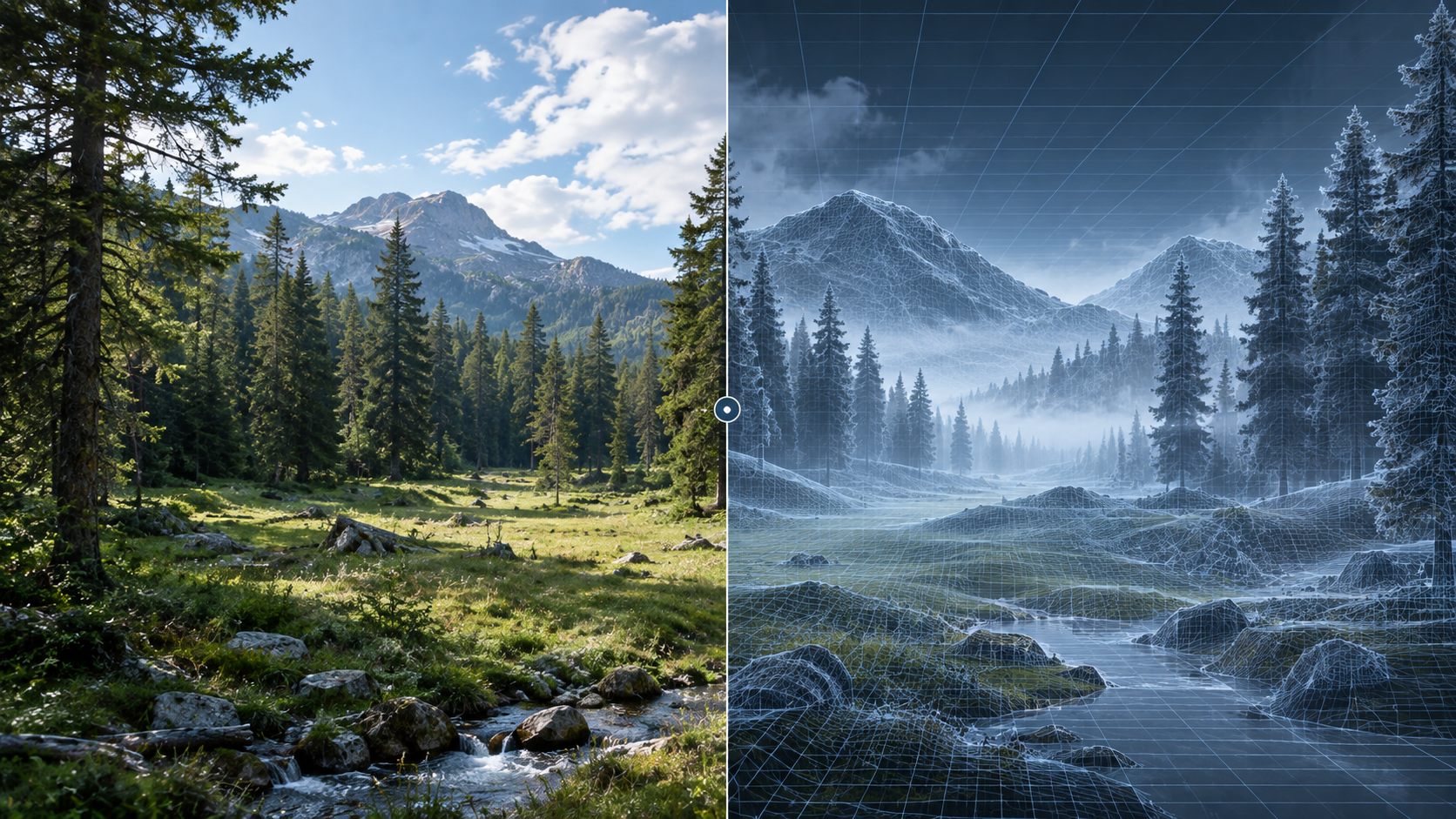
Its commercial product, Marble, is a multimodal world model that generates 3D worlds from text, images, and videos. In plain terms, World Labs turns a flat visual into something you can move through. That's the whole pitch behind World Labs: not prettier pixels, but navigable space. Marble is also the clearest example of what World Labs means by "spatial intelligence."
That's a different problem from image generation. An image generator produces a fixed frame; World Labs produces a space.
Why AMD Paid $8.2 Billion
The deal logic runs in both directions. World Labs said AI development now requires "close collaboration across model research, systems, and compute" — in other words, it needs chips. AMD says understanding frontier workloads like those at World Labs will shape its chip-making roadmap. In that sense, buying World Labs is AMD buying a map of its own future silicon.
The two already had an inference-optimization and training partnership, and Fei-Fei Li appeared at AMD's CES presentation earlier this year. As part of the acquisition, Li joins AMD as executive vice president and chief scientist, so World Labs isn't being folded away — it's becoming AMD's research edge. That's an unusual outcome for an acquired startup, and it says a lot about how much AMD values the World Labs team.
Spatial Intelligence Is the Next Visual Frontier
Here's why this matters beyond semiconductors. For the past few years, visual AI has meant one thing: generating 2D images and video. World Labs points at what comes after — spatial intelligence, where models understand depth, physics, and volume well enough to build scenes you can walk through. AMD didn't buy World Labs for its pictures; it bought the World Labs thesis about physical grounding.
The pipeline is telling. A World Labs world often starts from an image. You generate a still, then hand it to a world model that extrapolates a 3D environment. Image generation isn't replaced by World Labs-style systems — it becomes the input.
What This Means for Creators
The World Labs acquisition pushes three conclusions for anyone making visuals:
- Images are the foundation — every 3D world needs source imagery, so strong World Labs-adjacent workflows still begin with a great image.
- Depth is becoming a requirement — prompts that describe space, scale, and camera position get more valuable as World Labs-style tools mature.
- Compute is the bottleneck — AMD buying World Labs confirms that spatial AI is compute-hungry, which is why frontier work clusters around chip makers.
Nobody is going to stop needing flat images because of World Labs. If anything, the appetite for good source visuals goes up — and producing those visuals is a skill World Labs doesn't replace.

A Prompt to Try Today
If spatial AI starts with an image, the image had better be good. Try this on Fanch AI:
Copy & Paste this into Fanch AI (Model: gpt_image_2):
Create a photorealistic wide establishing shot of a dramatic mountain valley at golden hour, with a winding river, layered ridgelines fading into atmospheric haze, and warm sunlight raking across the terrain in long shadows. Rich depth and clear foreground-to-background separation, cinematic wide-angle composition, natural color grading, 16:9 framing, 8K detail, no text.
Why Fanch AI Is the Starting Point
World Labs shows where visual AI is heading, but every 3D world still begins with a flat image — and that image has to be made. Fanch AI gives you a dedicated image model you direct with precise prompts, so you can produce the detailed source visuals that feed whatever comes next. Whether World Labs-style worlds become the norm or not, the images underneath them still matter.
👉 Start here: GPT Image 2 on Fanch AI — create the images that start it all.