
Diwali AI Photo Prompts: 7 Scenes, Grouped by Where You Post
Diwali lands on November 8, which means the prompt lists are already everywhere — and most of them are the same ten generic prompts with "Indian festival, diyas, warm light" at the top. That produces a Diwali AI photo that looks like every other one.
The problem is not the model. Most Diwali AI photo prompts fail because these lists treat Diwali as one mood, when it is actually a specific set of objects, colours, and light sources — and the Diwali AI photo you want depends entirely on where it is going to be posted.
So this is seven prompts grouped by platform, plus the failure modes that make a Diwali AI photo look wrong.
First, the Actual Visual Codes
Before prompting a Diwali AI photo, know the vocabulary. A convincing Diwali AI photo is built from a small number of recurring elements.
Diyas. Small unglazed clay oil lamps with a cotton wick, usually arranged in rows, on steps, or along a threshold. Their light is warm, low, and directional.
Rangoli. Floor art at the entrance, made from coloured powder, rice flour, or flower petals — geometric, symmetrical, and usually viewed from above.
Marigolds. Dense orange and yellow garlands strung across doorways, heaped in trays, floating in water.
Colour palette. Deep red, maroon, gold, emerald, and warm amber, against dark wood, stone, or night.
Mithai. Small sweets — ladoo, barfi, jalebi, kaju katli — on brass or steel trays, often dusted with silver leaf.
Attire. Sarees, lehengas, kurtas and sherwanis in silk and brocade with gold detailing.
Texture. Clay dust, brass, silk, marigold petals, powder. A Diwali AI photo that renders all of these as smooth plastic has failed, no matter how pretty it is.
One caution that saves a lot of bad output: Diwali is not one holiday. In Bengal the same night is Kali Puja, in Gujarat the new year brings Annakut, and in parts of the south Naraka Chaturdashi carries the story. A Diwali AI photo that smashes all of them together reads as "generic India" to everyone who knows the difference.
7 Diwali AI Photo Prompts by Platform
Each prompt is one scene, one light source, one camera move's worth of composition.
1. WhatsApp status / greeting — vertical
The Diwali AI photo most people actually need first. Portrait orientation, warm, personal, and clean enough to carry a text message over it later.
A vertical portrait composition on a dark wooden threshold: three clay diyas with lit cotton wicks arranged in a short row, warm flame light pooling on the wood grain, a scatter of marigold petals beside them, soft golden bokeh behind, deep shadow in the corners. Shallow depth of field, warm amber palette, fine texture in the unglazed clay, 9:16 framing, high detail, no people, no text.
2. Instagram grid — square
A Diwali AI photo for the grid needs a centred subject and room to breathe.
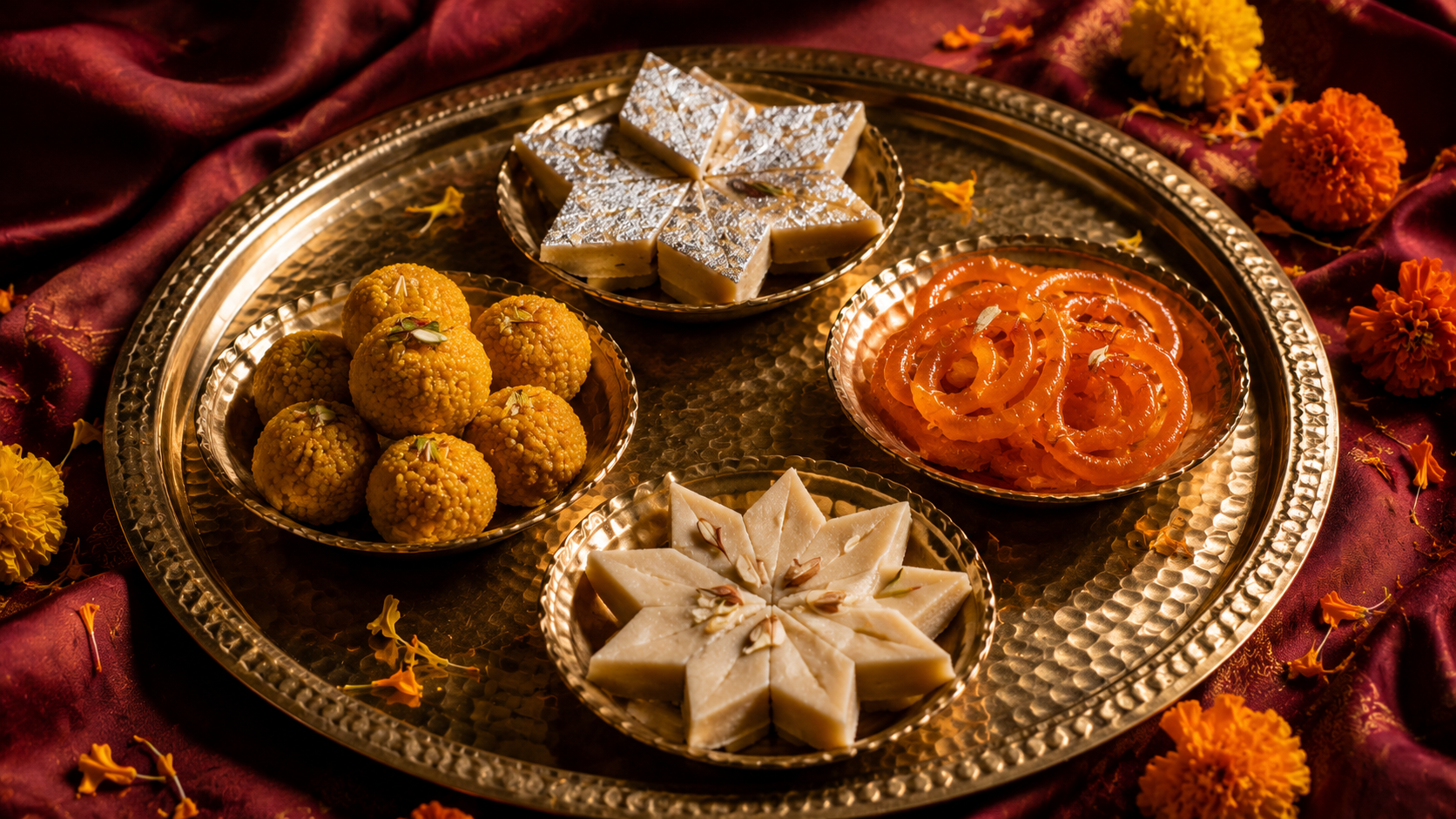
A square overhead composition of a brass tray on a maroon silk cloth: four small bowls of mithai — pale barfi dusted with silver leaf, golden ladoo, orange jalebi, pale kaju katli — with marigold petals scattered around the tray and one unlit diya at the corner. Soft warm side light, rich silk sheen, fine detail in the sugar texture and brass engraving, 1:1 framing, high detail, no people, no text.
3. Reels cover / story — vertical, high contrast
A Diwali AI photo used as a cover has to read at thumbnail size, which means strong light and strong shape.
A vertical close-up of a single lit clay diya held in the dark: the flame throwing warm amber light across the textured clay rim, fine soot marks visible, marigold petals blurred in the background bokeh, deep black surroundings. Dramatic single-source lighting, high contrast, shallow depth of field, 9:16 framing, high detail, no people, no text.
4. Home decor post — wide
The Diwali AI photo that shows a room, not an object. This is where most prompts fall down, because they forget architecture.
A wide interior composition of a traditional Indian living room prepared for the festival at dusk: rows of clay diyas along a low stone ledge, marigold garlands strung across a carved wooden doorway, warm lamplight against deep evening blue outside the windows, patterned floor cushions and a low wooden table. Warm amber and deep blue palette, rich texture in the stone and carved wood, cinematic wide framing, 16:9, high detail, no people, no text.
5. Rangoli detail — overhead
The geometry is the whole point, so prompt a Diwali AI photo like this one as a graphic, not a scene.
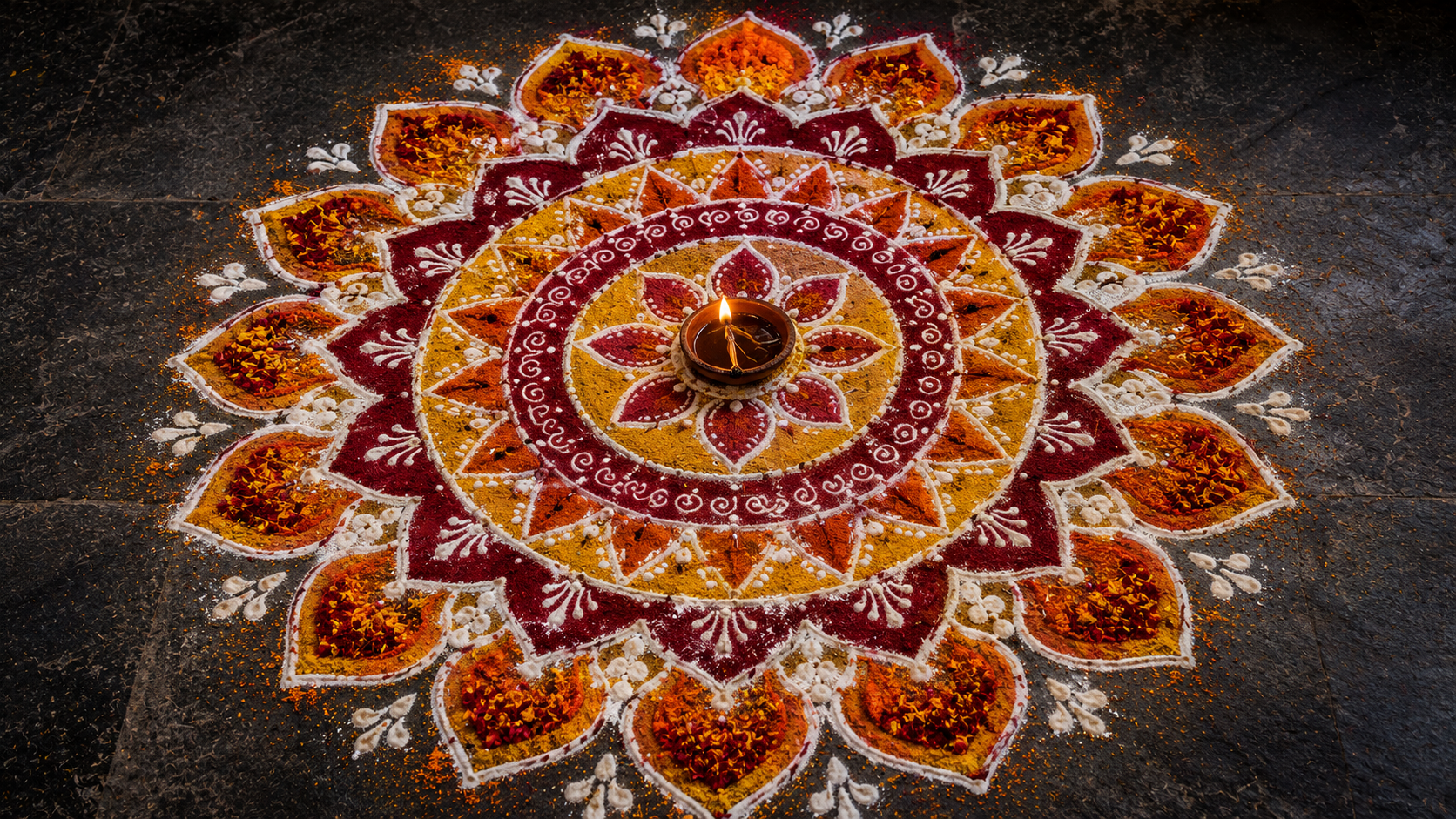
An overhead composition of a freshly drawn rangoli on a dark stone floor: concentric geometric rings in deep red, orange, yellow and white powder, fine petal details worked into the outer ring, a small clay diya placed at the centre, scattered powder dust around the edges. Flat overhead light with soft shadows, extremely fine granular texture, rich saturated colours against dark stone, 1:1 framing, high detail, no people, no text.
6. Family photo backdrop — wide, no faces
Sometimes you want the Diwali AI photo as a setting that people will be composited into later. Build it empty.
A wide composition of a decorated doorway at night, no people: a mango-leaf toran garland hanging across the top of the frame, marigold strings down both sides, a row of lit clay diyas on the step, warm lamplight glowing from inside the house, deep blue night beyond. Warm interior glow against cool exterior, rich texture in the leaves and clay, shallow depth of field, 16:9 framing, high detail, no people, no text.
7. Brand or corporate greeting — clean and safe
The Diwali AI photo a company can publish without anyone arguing about it. No people, no religious figures, no regional specificity.
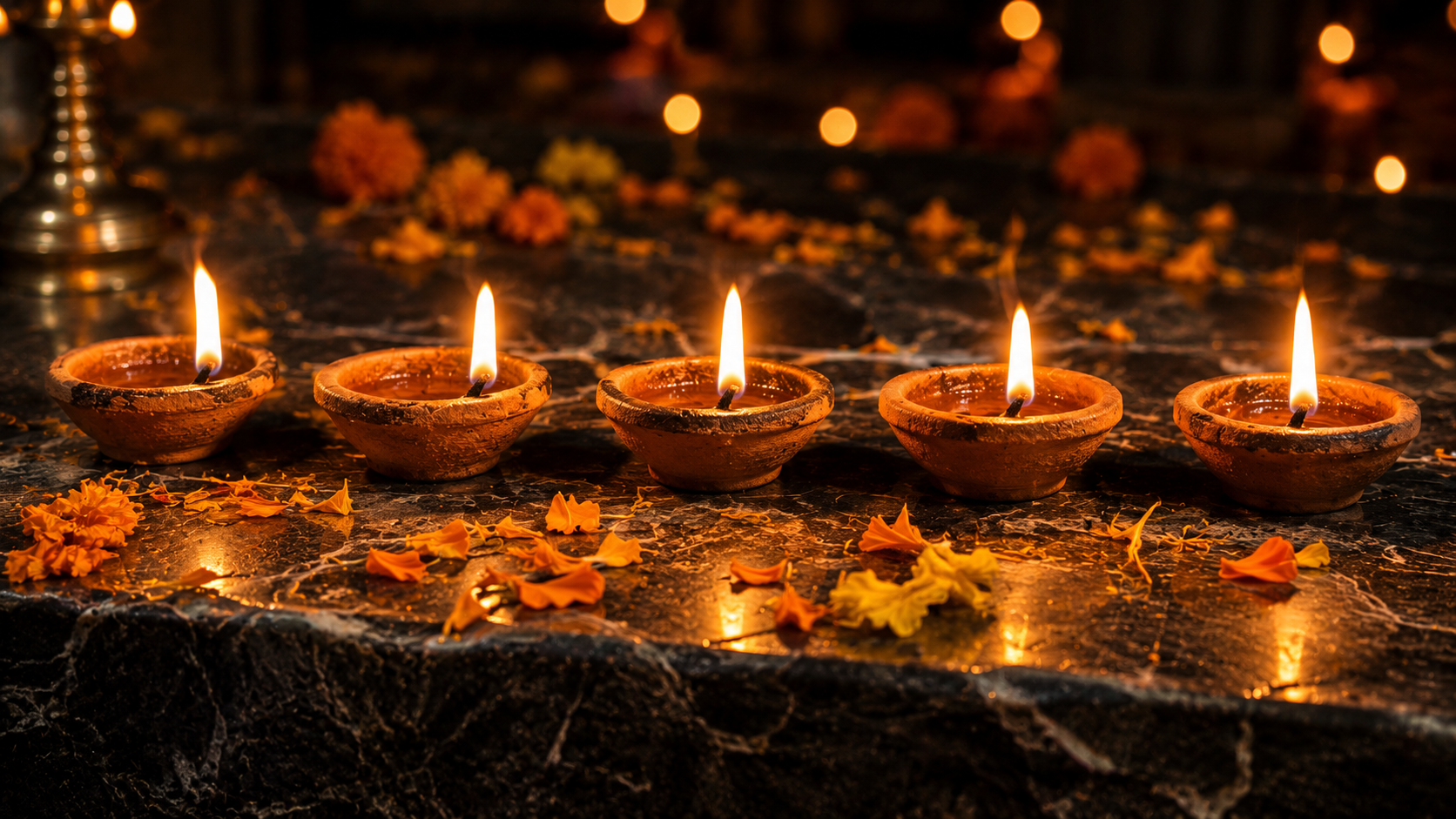
A refined composition of five lit clay diyas arranged in a gentle arc on a dark slate surface, marigold petals scattered between them, a soft warm glow spreading across the slate, dark neutral background falling into shadow. Restrained palette of amber, terracotta and charcoal, crisp detail in the clay and the petal veins, generous negative space at the top, 16:9 framing, high detail, no people, no text, no brand logos.
What Makes a Diwali AI Photo Look Wrong
Five failures show up again and again.
Plastic diyas. If the clay looks glazed, ceramic, or metallic, the Diwali AI photo loses its texture instantly. Add unglazed clay, matte, soot marks.
Christmas lights. The model has far more training data for holiday light strings than for diyas. Prompt clay oil lamps with cotton wicks for your Diwali AI photo, never festival lights.
Garbled rangoli. Symmetry is where diffusion models cheat. If the Diwali AI photo needs rangoli, use an overhead composition and describe geometry explicitly, or you get an asymmetric smear.
Over-lit HDR. Diwali is a dark scene with small warm sources. Say deep shadows, single-source flame light, and accept that a good Diwali AI photo is mostly dark.
Melted cultural specifics. Saree mixed with lehenga, rangoli in the wrong place, Kali Puja iconography in a Gujarat setting. Pick one tradition and describe it properly in any Diwali AI photo.
Prompt Safety and Cultural Respect
Three practical limits for any Diwali AI photo prompt.
Avoid depicting deities. Lakshmi and Ganesha are central to the puja, and generating images of them is both technically unreliable and culturally careless. Photograph the diyas, the garlands, and the sweets instead. Every prompt above does.
No photo-real children. Diwali imagery is full of family scenes. Keep subjects adult, or keep the Diwali AI photo empty and composite real people in later. If a child must appear, make it an explicit illustration.
No brand marks, no borrowed logos. A greeting that ships with someone else's logo on it is a problem nobody needs, so include no brand logos in the prompt.
Post Before November 8, Not On It
Timing matters more than a tenth prompt. Diwali searches peak in the two to four days before the festival, then collapse. A Diwali AI photo posted on November 8 competes with everyone's actual celebration photos and loses.
Best window for a Diwali AI photo: November 4 to 6. Post the greeting early, then the decor and food shots in the final two days.
A Prompt to Try
If you only generate one Diwali AI photo this year, make it the diya close-up — it is the warmest, safest, and most reusable image on this list.
Copy & Paste this into Fanch AI (Model: gpt_image_2):
A cinematic close-up of three lit clay diyas arranged in a short row on a dark stone ledge at night: warm flame light pooling on the rough unglazed clay, fine soot marks at the rim, a scatter of marigold petals beside them, deep shadow falling away behind. Shallow depth of field, warm amber palette against near-black, fine granular texture in the clay and stone, 16:9 framing, 8K detail, no people, no text overlay.
Then reuse it: the same Diwali AI photo works as a story background, a header, or the opening shot of a Reel.
Why Fanch AI Fits
A Diwali AI photo that reads as authentic comes down to getting the small things right — unglazed clay instead of ceramic, marigolds instead of fairy lights, powder texture instead of flat colour. That is prompt control for a Diwali AI photo, and it is the part you can iterate cheaply.
Fanch AI gives you a dedicated image model you direct with precise prompts, so you can lock the light source, the texture and the palette before the festival window closes.