
AI Slop Backlash: LinkedIn's Flag Button, 1M Clicks | Fanch AI
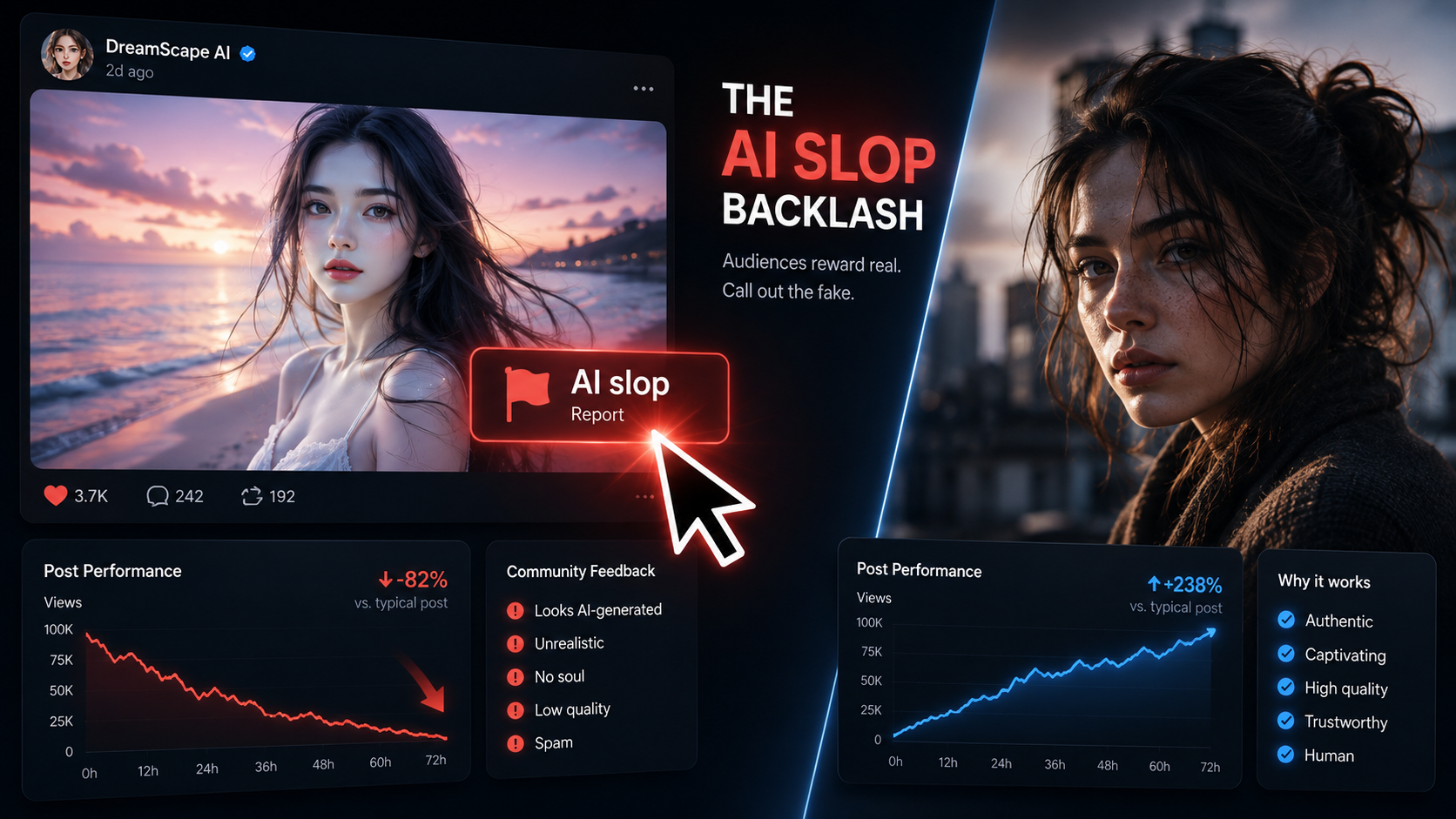
AI slop just hit its biggest backlash moment yet. LinkedIn's "Seems like AI slop" button — launched July 30 — has been clicked by over one million people, and the platform says content it classifies as AI slop now gets 40% fewer views than it did a few weeks ago. The button is one signal among many that the free ride for low-effort AI content is ending: platforms are demoting it, watermarking it, and telling creators their posts look machine-made. Here's what the AI slop backlash means for anyone making AI images and videos — and how to make AI content that doesn't get flagged.
The AI slop problem got real fast. An analysis by AI detector Pangram found that 41 percent of LinkedIn's longform posts were flagged as fully AI generated — a stat that 404 Media reported and that LinkedIn clearly took seriously. The company added the AI slop button, improved its AI classifiers, and even removed a feature that would "enhance your post" with AI. As LinkedIn's chief product officer Hari Srinivasan put it: "AI slop is a top priority for all of us."
1. What Happened: LinkedIn's AI Slop Button Passes One Million Clicks
The AI slop button lives in the three-dots menu on any post. Click it, and LinkedIn logs your signal that the post seems machine-generated. According to Srinivasan's post, more than a million people have already used it — and the results are measurable: AI slop is now seeing "40% less views" than it did a few weeks ago.
LinkedIn isn't stopping at the button. The platform is also telling posters directly — "Some members told us this post seems like AI" — as feedback on future posts, and it's cracking down on AI-generated comments created at scale "with little or no human involvement." The message is unmistakable: mass-produced AI slop is now a demotion risk, not a growth hack.
2. Why Platforms Are Now Policing AI Content
The AI slop crackdown isn't just LinkedIn. It's the logical end of a year in which AI-generated content flooded every feed, and it connects directly to the provenance changes we've covered: Google made Gemini's visible watermarks optional while keeping invisible markers, Anthropic started watermarking all Claude output, and Meta launched its Content Seal. Platforms are converging on the same playbook — detect AI content, label it, and demote the low-quality version.
The economics explain why. AI slop destroys engagement: readers scroll past generic AI images and hollow AI-written posts, so platforms that let AI slop dominate lose retention. LinkedIn's data — a million flags and a 40% view cut — is the first public proof that users will actively police AI content if you give them a button. The AI slop era of easy reach is over.
3. What This Means for AI Image and Video Creators
Here's the good news: the AI slop backlash doesn't punish AI content — it punishes lazy AI content. The distinction matters for anyone using an AI image generator for real work.
Specificity beats templates. AI slop looks generic because it's prompted generically. A prompt with a specific subject, place, light, and intent produces content that reads as intentional.
Editing is the signal. AI content that has been cropped, regraded, or refined reads as crafted. Raw one-shot output reads as AI slop.
Originality is protection. Rehashing the same viral prompt everyone else used is exactly what the classifiers are trained to catch. Original scenes and characters don't get flagged.
Provenance is coming for everything. With watermarks, metadata, and platform classifiers all active, the goal isn't to hide that you used AI — it's to make AI content good enough that nobody cares.
4. 5 Prompts for AI Images That Don't Look Like Slop
The best defense against the AI slop backlash is simply better images. Every prompt below is specific, editorial, and original — the opposite of AI slop — and every one runs on Fanch AI right now:
Prompt 1 — A specific narrative moment:
A lone fisherman mending his net on a concrete dock in Reykjavik at 4 AM, single sodium streetlight, cold blue air, coffee cup steaming on a crate beside him, documentary photography style, 35mm grain, authentic weathered hands, photorealistic.

Prompt 2 — Editorial product photography with art direction:
Editorial product photograph of a copper pour-over coffee kettle on a raw linen tablecloth, warm window light from the left, a single torn page of a recipe notebook in soft focus behind it, shallow depth of field, muted earthy palette, magazine art direction, photorealistic.
Prompt 3 — Original character with backstory detail:
Cinematic portrait of an original character: a retired train conductor in his 70s, brass pocket watch in hand, standing in an abandoned railway station with peeling green paint, dust motes in a shaft of light, worn uniform with visible stitching, emotional realism, film still quality.

Prompt 4 — A specific time and place:
Golden hour over a terraced rice field in northern Vietnam, a farmer in a conical hat walking the narrow ridge, mist rising from the valley below, saturated greens with warm highlights, National Geographic photography style, sharp detail, photorealistic.
Prompt 5 — Documentary candid moment:
Candid documentary shot of a street food vendor in Bangkok flipping pad thai over a blazing wok, sparks and steam, neon sign reflections on wet asphalt, motion blur on the hands, sharp face in focus, reportage photography, photorealistic.
Each prompt is built around a specific subject, setting, and intent — the three things AI slop never has. Run them on Fanch AI, add a little editing, and your output reads as intentional work, not machine filler.
5. Start Creating Non-Slop AI Images on Fanch AI
The AI slop backlash is a gift to serious creators: as generic AI content gets demoted, quality AI content gets the attention. On Fanch AI — an AI image generator built for editorial quality — you can create the kind of specific, intentional images that survive platform classifiers, with GPT Image 2, Nano Banana 2, and other top models ready in your browser.
👉 Start here: GPT Image 2 on Fanch AI